




The Holy Grail: D&D’s Ultimate Legendary Artifact
In our last installment of Legendary Artifacts Reimagined, we explored the Philosopher’s Stone, the legendary alchemical substance capable of transforming matter, creating gold, and potentially granting the secret of eternal life.
The Philosopher’s Stone asked a dangerous question:
What would you change if you could change anything?
Now we’re moving from alchemy to legend, from laboratories to castles, and from the secrets of transformation to perhaps the most famous legendary relic of all.
The Holy Grail.
Few objects in mythology have inspired as many stories, quests, theories, adventures, and terrible decisions as the Grail. Depending on the tradition, it has been a cup, a dish, a sacred vessel, a miraculous object, or something much stranger. Its legends developed through medieval literature, particularly Arthurian romances, with Chrétien de Troyes’s Perceval helping establish the Grail as a central mystery of the Arthurian world. Later writers, including Robert de Boron, connected it more explicitly to the Last Supper and Joseph of Arimathea.
And then, in 1975, five men with a questionable relationship with medieval history introduced an entirely different generation of adventurers to the Grail.
Because if you’re going to send a group of D&D players on a quest for the holiest relic in history, you should probably be prepared for someone to ask where they parked their invisible horse.
What Is the Holy Grail?
The first thing that makes the Holy Grail so useful in D&D is that there isn’t one universally agreed-upon version of it.
That’s not a problem.
That’s an opportunity.
The Grail has been described in different traditions as a vessel associated with the Last Supper and the blood of Christ, while earlier Grail romances presented something less clearly defined. In some medieval stories, its exact nature is mysterious enough that the object almost becomes secondary to the quest itself.
That’s perfect for a Dungeon Master.
The Holy Grail doesn’t need a single canonical stat block.
Maybe it is a golden chalice.
Maybe it’s an ancient wooden cup that looks completely ordinary.
Maybe it’s a crystal vessel that never becomes dirty.
Maybe it’s a bowl carved from a mysterious stone.
Maybe it isn’t even a cup at all.
The characters have heard a dozen different descriptions, and every one of them might be wrong.
The important thing is that everyone believes the Grail exists.
And everyone believes it can do something extraordinary.
What Does the Holy Grail Actually Do?
This is where the Dungeon Master gets to decide what kind of campaign they’re running.
Perhaps the Grail is the ultimate healing artifact.
A single drop of liquid from the Grail could cure any disease, remove any poison, restore a lost limb, or heal wounds that no mundane magic can touch.
Perhaps drinking from it restores youth.
Perhaps it can restore someone who has died, provided their soul has not passed beyond a certain point.
Perhaps the Grail produces an inexhaustible supply of pure water.
Perhaps anything poured into the Grail becomes purified.
Poison becomes water.
Disease becomes health.
Defiled water becomes pure.
Cursed substances lose their corruption.
That alone makes the Grail incredibly valuable.
But what if the Grail’s greatest power isn’t healing?
What if it reveals truth?
Perhaps someone who drinks from it cannot lie.
Perhaps it allows the drinker to see the true nature of another creature.
Perhaps it reveals illusions, disguises, shapeshifters, and magical deceptions.
Perhaps it shows the drinker a vision of something they desperately need to understand.
Now the Holy Grail isn’t simply a healing item.
It becomes a divine answer to one of the oldest problems in fantasy:
How do you know what is true?
The Grail Should Feel Different

A Vallis Crystal is one of the new magic items in Emirikol’s Guide to Devil. Yep, it’s got new magic items too! This one opens up whole new worlds… [Art by Kagurachi]
The Grail should feel important before anyone knows what it does.
Imagine the party entering a ruined chapel.
The room is covered in dust.
The altar is broken.
The stained glass windows have been shattered for centuries.
And yet, sitting on the altar is a completely spotless cup.
No dust.
No cracks.
No decay.
Nothing around it has survived the centuries intact.
Except the Grail.
The characters don’t need an inscription explaining what it is.
They should immediately wonder.
Is that it?
And perhaps the most terrifying answer is:
Maybe.
The Worthy Problem
The idea of worthiness is where the Holy Grail becomes particularly interesting for D&D.
Who is worthy to use it?
A paladin?
A cleric?
A saint?
A hero?
Someone without sin?
Someone willing to sacrifice everything for another person?
Or perhaps the Grail doesn’t care about alignment at all.
Maybe it cares about intention.
A selfish person might drink from it and receive nothing.
A ruthless adventurer might successfully use it to heal someone else but find the Grail powerless when used for personal gain.
A villain might be able to hold it.
They simply can’t make it work.
And then you have the most interesting possibility of all.
What if there is no objective definition of “worthy”?
What if the Grail responds differently to every person?
The paladin thinks worthiness means purity.
The rogue believes it means courage.
The wizard believes it means wisdom.
The cleric believes it means faith.
And the Grail reveals that all of them misunderstood the question.
That could create an incredible character moment.
Challenges for Players
The biggest challenge with the Holy Grail is figuring out what it actually is.
The party might spend an entire campaign chasing a golden cup only to discover that the Grail isn’t made of gold.
They might follow ancient maps.
They might decipher dead languages.
They might negotiate with religious orders.
They might explore forgotten monasteries.
They might battle undead knights guarding ruined castles.
They might discover that another adventuring party is searching for the Grail at the same time.
And every clue might contradict the previous one.
That’s not necessarily a flaw.
The Grail has been surrounded by mystery for centuries.
The quest should feel like a mystery.
More importantly, the characters shouldn’t necessarily know what they’re looking for.
The party might be told:
“Find the cup.”
But the actual clue might mean:
“Find the vessel.”
And the vessel might not be a cup.
This is where the Grail can become more than a treasure hunt.
It becomes a campaign-long puzzle.
How Players Can Overcome These Challenges

Evil D&D magic sword
Players shouldn’t solve the Grail quest simply by rolling a sufficiently high History check.
Research should matter.
Ancient texts should matter.
Talking to sages should matter.
Listening to contradictory legends should matter.
The players should gradually assemble a picture from fragments.
One source says the Grail is in a castle.
Another says it is beneath a church.
Another says it was carried across the sea.
Another insists it never existed.
And somewhere in all those stories is the truth.
Maybe.
That’s the fun.
Players should also be encouraged to question the assumptions behind their quest.
If every legend says the Grail grants eternal life, why?
If every guardian says only the worthy can use it, what does that actually mean?
If three different religions claim the Grail belongs to them, who is telling the truth?
And if the Grail really can cure every disease and heal every wound, why hasn’t someone already used it to change the world?
Those questions can lead the party toward the real adventure.
Challenges for Dungeon Masters
The Holy Grail creates a different problem from the Philosopher’s Stone.
The Philosopher’s Stone can break the economy.
The Holy Grail can break the consequences of adventuring.
If it can heal everything, cure everything, and resurrect everyone, suddenly death becomes considerably less frightening.
The answer isn’t necessarily to make the Grail weak.
Instead, make its power meaningful.
Perhaps the Grail can heal any wound, but only when used for someone other than yourself.
Perhaps it can cure any disease, but it cannot reverse natural aging.
Perhaps it can restore the dead, but only once.
Perhaps the Grail can perform miracles, but each miracle requires an act of genuine sacrifice.
Or perhaps it has no mechanical limitation whatsoever.
The limitation is access.
The Grail doesn’t belong to the adventurers.
It belongs in a sacred place.
And if the players take it, they’re responsible for deciding what happens to everyone else who needs it.
That is a much more interesting problem.
The Grail and the Fisher King
One of the most useful pieces of Arthurian Grail mythology for a D&D campaign is the Fisher King.
In Grail traditions, the Fisher King is a wounded ruler whose condition is connected to the wasteland around him, and the Grail becomes part of the quest to restore what has been broken.
That’s an incredible campaign premise.
Imagine the players entering a kingdom where nothing grows.
The rivers are polluted.
Animals are disappearing.
People are sick.
The king lives in an ancient castle but never leaves his chambers.
Every night, he sits beside a pool and fishes.
The party is told that the kingdom can only be restored when the Holy Grail is found.
So they begin their quest.
Eventually, they discover something unexpected.
The king isn’t waiting for the Grail.
He’s waiting for someone to ask the right question.
Now the entire adventure becomes a test of the characters.
Not their combat abilities.
Not their ability to solve puzzles.
Their ability to understand what the Grail actually represents.
And Then There’s Monty Python
Of course, we can’t talk about the Holy Grail and D&D without talking about Monty Python and the Holy Grail.
The movie was released in 1975 and follows King Arthur and his knights as they embark on a quest for the Grail. The film deliberately tears apart the conventions of medieval adventure stories, including heroic quests, Arthurian legends, and the very idea that knights riding around looking for a sacred artifact should be taken seriously.
It also gave generations of tabletop gamers an entirely different set of references to work with.
The coconut horse.
The Black Knight.
The French castle.
The Knights Who Say “Ni.”
Tim the Enchanter.
The killer rabbit.
The absurdly dangerous bridge.
And, of course, Camelot being described as a rather silly place.
For a D&D group, these aren’t just jokes.
They’re practically encounter ideas waiting to happen.
Imagine the party approaching an ancient castle.
They hear the sound of hooves.
They prepare for a mounted knight.
Instead, a commoner follows behind the knight, loudly banging coconuts together.
The party stares.
The knight stares.
The commoner continues.
Nobody acknowledges the problem.
That is exactly the kind of ridiculous encounter that can become legendary around a gaming table.
The Black Knight Problem
The Black Knight is another perfect piece of inspiration.
A heavily armored warrior guards an important passage.
The party defeats him.
He refuses to move.
They cut off his arm.
He keeps fighting.
They defeat him again.
He keeps insisting everything is fine.
For a Monty Python-inspired D&D encounter, you can absolutely lean into the absurdity.
But there is another way to use the idea.
What if the Black Knight is actually a guardian of the Grail?
He has been protecting the passage for centuries.
He cannot be convinced to leave.
He cannot be bribed.
He cannot be intimidated.
He simply refuses to allow anyone past.
And every time the characters defeat him, he gets back up.
Eventually the players realize something.
They aren’t supposed to defeat him.
They’re supposed to understand why he’s there.
That transforms a comedy encounter into a legitimate Arthurian-style test.
And it still gives the table plenty of opportunities for ridiculous banter.
The Knights Who Say Ni

The Knights Who Say Ni are another gift to any Dungeon Master willing to embrace the silliness.
Perhaps the players need information from a mysterious order of knights.
The knights agree to provide it.
But first, the characters must bring them something completely unreasonable.
Shrubbery is an obvious choice.
But you don’t have to stop there.
Maybe they demand a very specific type of tree.
Maybe they want a hedge shaped like a dragon.
Maybe they need a garden that can only grow upside down.
Maybe they require a shrubbery guarded by a dryad who absolutely refuses to cooperate.
The joke becomes an actual adventure.
And that’s one of the things Monty Python and the Holy Grail does particularly well.
It demonstrates that a quest doesn’t have to be solemn every moment to still feel epic.
D&D can contain gods, demons, dragons, world-ending threats, and cosmic horror.
It can also contain a man arguing about coconuts.
Both are perfectly valid.
What Happens If the Grail Is Fake?
Here’s an especially fun possibility.
The players spend an entire campaign searching for the Holy Grail.
They finally find it.
It’s sitting inside an ancient temple.
Divine light shines from above.
The room fills with celestial music.
The characters approach.
And then they discover that it isn’t the Grail.
It’s a decoy.
Maybe the real Grail was moved centuries ago.
Maybe the church guarding it has been protecting the wrong artifact.
Maybe the Grail itself has been traveling from place to place.
Or perhaps there never was a physical Grail.
Maybe the quest itself is the point.
That idea fits surprisingly well with the historical development of the legend. The Grail wasn’t one fixed object from the beginning; medieval authors developed and transformed the concept over time.
For D&D, that means the Dungeon Master has permission to make the Grail whatever the campaign needs it to be.
What Happens If Someone Drinks From It?
This should be one of the biggest moments in the campaign.
The character raises the cup.
Everyone watches.
They drink.
What happens?
Maybe nothing.
Maybe they are completely healed.
Maybe they experience every moment of their life simultaneously.
Maybe they see the future.
Maybe they meet a deity.
Maybe they remember a past life.
Maybe they learn one absolute truth about the universe.
Or perhaps the Grail simply asks them a question.
What do you seek?
The character answers.
And the Grail responds.
Not with a reward.
With an opportunity.
Because the most interesting version of the Holy Grail isn’t an artifact that gives characters everything they want.
It’s an artifact that reveals what they truly need.
Can the Holy Grail Be Destroyed?

Oreamnos, or goatfolk, g0t the spotlight in Nerdarchy’s Patreon rewards for June 2018. A new player race, monster, magic items, NPC, organization, background and complete adventure ready to drop into your 5E games awaits! One of these unusual folk would certainly make a memorable NPC. [Art by Nelson Vieira]
Maybe it cannot be destroyed.
Maybe attempting to destroy it causes the weapon or spell to simply fail.
Maybe it repairs itself.
Maybe destroying it requires someone to willingly sacrifice themselves.
Or perhaps the Grail is not indestructible.
Perhaps destroying it is incredibly easy.
The real problem is what happens afterward.
The Grail breaks.
The divine liquid spills across the ground.
Every drop becomes a miracle.
Plants bloom.
The dead stir.
Wounds close.
Curses disappear.
And suddenly the entire region becomes a place of impossible healing.
The players succeeded.
They also created a new problem.
That’s the kind of consequence that makes a legendary artifact memorable.
The Holy Grail as a D&D Campaign
The Holy Grail can be the centerpiece of an entire campaign.
The party could begin with nothing more than a fragment of an ancient map.
They discover that several factions are searching for the Grail.
A knightly order wants to protect it.
A king wants to control it.
A cult wants to destroy it.
A lich wants to drink from it.
A dragon believes it contains enough divine power to make the dragon immortal.
And somewhere out there, another adventuring party is already ahead of the characters.
The campaign becomes a race.
Ruined castles.
Ancient monasteries.
Forgotten battlefields.
Enchanted forests.
Cursed islands.
Underground temples.
The characters follow clues left behind by knights who searched for the Grail hundreds of years before them.
Eventually, they reach the final location.
And there it is.
The Holy Grail.
Waiting.
The Real Power of the Holy Grail
The Holy Grail is powerful because everyone wants something different from it.
A wounded person wants healing.
A dying king wants immortality.
A priest wants proof of faith.
A wizard wants to understand its magic.
A paladin wants to protect it.
A villain wants to possess it.
An adventurer might simply want to become famous for finding it.
The Grail doesn’t have to judge any of them.
It simply provides the opportunity to reveal who they are.
That’s what makes it such a good legendary artifact for D&D.
The Holy Grail isn’t just treasure.
It’s a test.
The journey toward it tests the characters.
The guardians test them.
The final chamber tests them.
And, perhaps most importantly, what they do after finding it tests them.
Do they keep it?
Destroy it?
Hide it?
Give it to a church?
Give it to a king?
Use it to heal the world?
Use it to save one person?
Do they drink from it themselves?
There isn’t necessarily a correct answer.
That’s the beauty of the Grail.
The artifact doesn’t need to tell the players what to do.
It gives them a choice.
And D&D has always been at its best when the players have to decide what happens next.
The Holy Grail in Your D&D Campaign
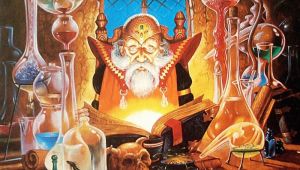
The Hand of Midas asked what happens when everything becomes valuable.
The Spear of Destiny asked what happens when nothing can stand against you.
Pandora’s Box asked whether some things should remain unopened.
The Ring of Gyges asked what you would do if no one could hold you accountable.
The Apple of Discord turned desire against itself.
The Horn of Roland called out across the world and waited to see what answered.
The Cintamani gave people the things they desired.
The Mirror of Narcissus showed people who they might become.
The Philosopher’s Stone gave them the power to transform the world around them.
And now the Holy Grail asks something different.
What would you do if you were given the power to perform a miracle?
That question makes the Grail almost perfect for D&D.
Because every adventuring party eventually reaches a point where they have the power to change the world.
The Holy Grail simply makes that moment tangible.
And if you want to add a little Monty Python to your campaign, that’s perfectly acceptable too.
Just remember to check for coconuts before accusing anyone of riding a horse.
And if someone tells you they’re looking for a shrubbery, maybe don’t ask questions.
The last time an adventuring party did that, things got considerably more complicated.
Next time in Legendary Artifacts Reimagined, we’re leaving the sacred relics of medieval legend behind and turning toward another legendary object whose story has been warning people about unchecked power for centuries: the Sword of Damocles. Because sometimes the most dangerous weapon isn’t the one you can swing. Sometimes it’s the one that makes you realize just how fragile your position really is.
Thanks for reading. Until Next Time, Stay Nerdy!!





No Comments